
Sustainable interior design is a series of better decisions
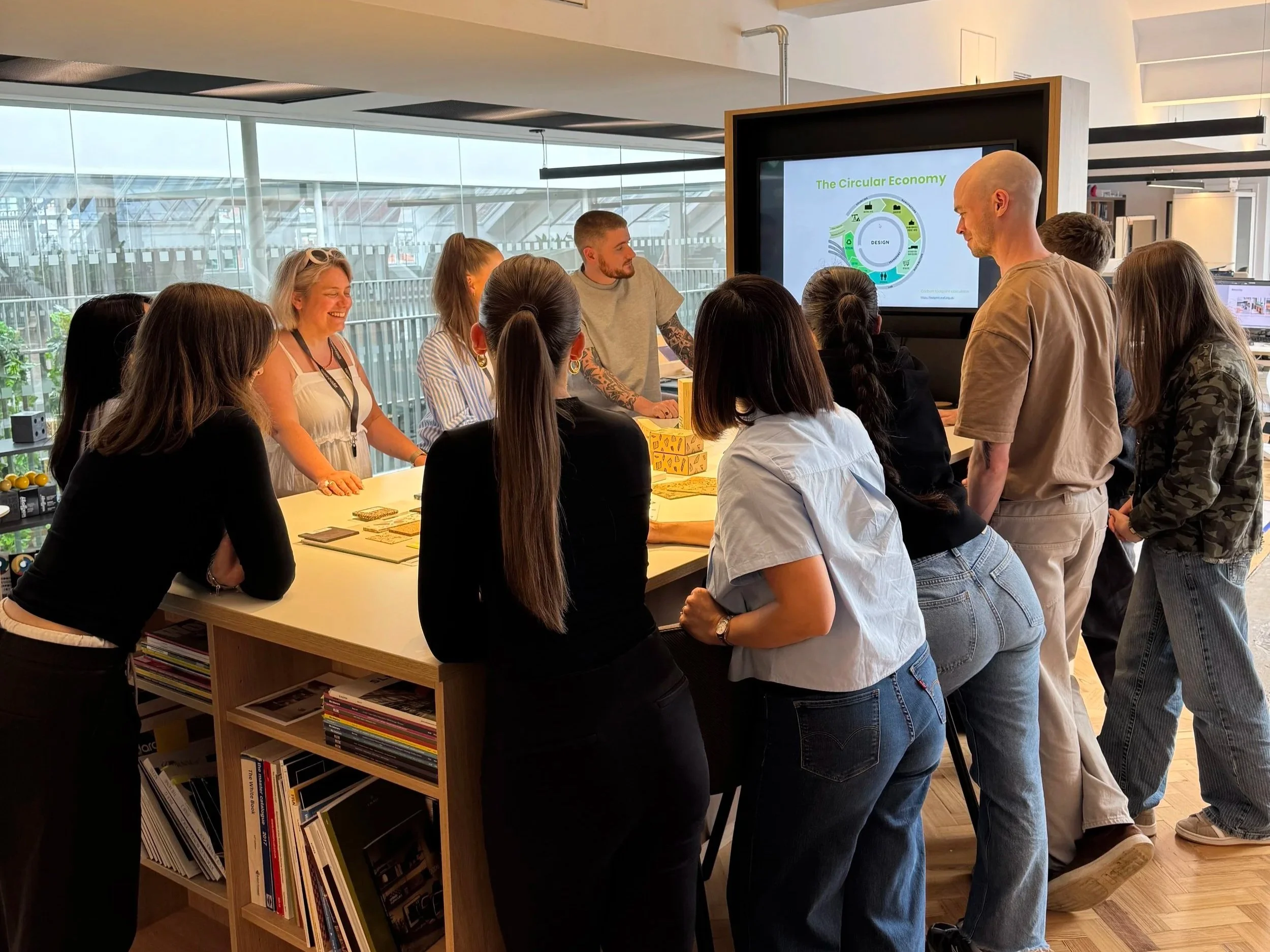
The SpaceInvader team explores how circular design, material innovation and changing expectations can inform project decisions.
Sustainability is sometimes presented as a product choice: a recycled surface, a low-carbon finish or a piece of furniture made from waste.
Materials matter, but they are only one part of the process. The environmental impact of an interior is shaped by a much wider series of decisions, beginning with what already exists and continuing through design, specification, installation, operation and eventual reuse.
As a B Corp, SpaceInvader is committed to examining those decisions and sharing knowledge across the studio. A recent team session led by Abbie, Millie and James explored circular design, material innovation and the changing expectations influencing commercial interiors.
The discussion reinforced a simple point: sustainability is most effective when it is part of everyday design thinking, rather than a separate exercise carried out after the main decisions have been made.
Start with what can be prevented
Recycling is valuable, but it sits below prevention and preparation for reuse in the waste hierarchy. UK government guidance places the options in a clear order: prevent waste first, prepare items for reuse, then recycle before considering other recovery or disposal. UK waste-hierarchy guidance
For an interior project, that means the first question should not necessarily be, “What sustainable product can replace this?” It should be, “Does this need to be replaced?” Existing floors, ceilings, partitions, joinery and furniture may be capable of retention, repair or adaptation. Even where an element cannot continue in its original role, it may have value elsewhere in the project.
This approach can reduce demand for new materials while preserving some of the character and history already held within a building. It can also help clients direct their budgets towards interventions that deliver greater operational or experiential value. Reuse requires early investigation. Existing elements need to be surveyed, tested and understood before demolition or procurement decisions remove the opportunity to retain them.
Design for a longer and less predictable future
A material with strong environmental credentials is not automatically a responsible choice if it needs to be replaced prematurely. Durability, maintenance and adaptability all affect the long-term impact of an interior. Commercial environments must withstand real patterns of use, cleaning and repair, whether they are workplaces, hotels, stadiums or public spaces.
Designing for longevity therefore involves looking beyond the initial installation. Project teams should consider:
Whether finishes can be repaired locally
Whether furniture components can be replaced separately
How easily materials can be cleaned and maintained
Whether layouts can adapt without extensive strip-out
If products can be separated when they reach the end of their current use
Whether manufacturers offer take-back, refurbishment or reuse schemes
Design for disassembly is particularly important. Mechanical fixings, modular components and reversible construction methods can make future alterations less destructive, helping materials retain their usefulness rather than becoming mixed waste.
Consider the complete material journey
Material selection has traditionally focused on appearance, performance, availability and cost. These remain essential, but designers are increasingly examining a broader set of questions. Where did the material come from? What resources and processes were involved in making it? How far has it travelled? Can its environmental claims be verified? What will happen when it is no longer needed in its current location?
Material passports and improved product data are helping teams record this information. Used effectively, they can give future owners and contractors a clearer understanding of what a space contains and how those materials could be recovered. Local sourcing can also shorten supply chains and strengthen the connection between a project and its location. It may support regional manufacturers and craftspeople while giving design teams closer access to the people who understand how a product is made, maintained and repaired.
Local is not automatically lower impact, however. Transport is only one part of a material’s environmental footprint, so decisions still require evidence and consideration of the full lifecycle.
Material innovation is widening the conversation
The studio session included a hands-on review of products made from agricultural, textile and manufacturing waste, alongside natural finishes and materials developed as alternatives to more carbon-intensive products. Examples included HempWood, which combines compressed hemp with a plant-based adhesive to create a timber substitute. Its manufacturer describes the product as carbon negative, free from added toxic VOCs and harder than oak flooring.
Denimolite transforms unwanted denim and manufacturing offcuts into solid sheets and panels for furniture and interior applications. Its process uses a bio-resin made with renewable plant-based glycerol rather than conventional petroleum-based propylene. Clay-based finishes provide another route. Clayworks’ rammed-earth finish adapts the appearance and material qualities of traditional rammed-earth construction into a thin finish suitable for contemporary interiors and retrofit projects.
The team also considered ceramic products that incorporate waste generated by other industries. Granby Workshop has developed encaustic tiles using unavoidable ceramic-industry waste while maintaining the colour, variation and durability associated with traditional vitrified tiles.
These materials are visually compelling, but appearance and headline credentials are not enough. Each specification still requires careful assessment of certification, fire performance, cleaning, durability, availability, lead times and suitability for the intended environment. Material innovation creates more options. Good specification determines whether those options work in practice.
Hospitality makes the trade-offs particularly visible
Hotels illustrate the complexity of sustainable interior design particularly well. Materials must support a clear design concept while meeting brand standards, guest expectations and intensive operational requirements. Floors, furniture and wall finishes may be exposed to frequent cleaning, luggage movement, food and drink, and high levels of daily use. A finish that performs poorly or is difficult to repair can create more waste over the life of the hotel, irrespective of its original sustainability claims.
There are nevertheless significant opportunities. Early engagement with local makers can help embed place into the concept while supporting shorter and more transparent supply chains. Furniture can be specified with replaceable covers, repairable components and separable materials. Carpet tiles and other finishes can be selected alongside credible manufacturer take-back arrangements.
The scale of hospitality projects also means that repeated decisions matter. Improving the specification of one chair, floor finish or guest-room element may have an effect across hundreds of individual items. The aim is not to compromise comfort or perceived quality. It is to understand how luxury, durability and environmental responsibility can reinforce one another.
Shared knowledge leads to better project decisions
Sustainable design knowledge cannot sit with one person or be introduced only at a formal review stage. Interior projects move quickly, and decisions are made across concept design, technical development, specification, procurement and construction. Designers at every level need the confidence to question whether something can be retained, whether a supplier claim is sufficiently robust and whether another solution could deliver better long-term value.
Studio sessions create space for these conversations before a decision is attached to a live deadline. Designers can handle unfamiliar materials, compare information and discuss how emerging ideas could perform across different sectors. They also provide an opportunity to challenge assumptions. A familiar product is not necessarily the most dependable choice, just as a newly developed material is not automatically the most sustainable.
Questions worth asking on every project
Sustainable interior design becomes more practical when broad ambitions are translated into consistent questions:
What can be retained before strip-out begins?
Can existing elements be repaired, adapted or used elsewhere?
Is the proposed design flexible enough to accommodate future change?
Can components be removed without damaging the surrounding materials?
Are environmental claims supported by credible product information?
How will the finish perform under real cleaning and maintenance conditions?
Are replacement parts or refurbishment services available?
Does the manufacturer operate a workable take-back scheme?
Where will the material go at the end of its current use?
Can the project team record the information future users will need?
No individual answer makes an interior sustainable. Together, however, these decisions can reduce waste, extend material lifecycles and create spaces that remain useful for longer.
For SpaceInvader, this is where the B Corp commitment becomes part of design practice: in the questions asked, the knowledge shared and the choices made throughout each project.
Explore SpaceInvader’s approach to purpose, impact and responsible interior design.